
Glamping Site Selection Australia
The Variables That Determine
Your Nightly Rate Ceiling
Site selection is the highest-leverage decision in a glamping operation. Get it right and every dollar you spend on units, fit-out, and marketing compounds. Get it wrong and no amount of effort recovers the shortfall. This guide covers what experienced operators evaluate — and what they avoid.
Why Site is Everything
A $480/night booking and a $220/night booking are often the same capsule in a different location
The short-stay accommodation market prices location more aggressively than almost any other factor. A Joey Luxe Jetstone on a ridge in the Yarra Valley with an unobstructed sunrise view will book for $180–$260 more per night than the same unit in a flat paddock twenty minutes away with no outlook — not because of the unit, but because of where it sits.
This is the central insight that experienced glamping operators carry. The asset — the capsule — is fixed. The location is the variable that either expands or contracts its revenue ceiling. That makes site selection the decision that shapes everything downstream: nightly rate, occupancy, review sentiment, marketing ease, and ultimately payback period.
This guide covers the six criteria that determine a site's rate potential, the demand drivers that underpin occupancy, the planning and access factors that determine feasibility, and the red flags that look viable on a map but fail in practice.
Location Tiers
The four rate tiers — what separates them
| Tier | Site characteristics | Jetstone nightly rate | Juniper nightly rate | Annual occupancy |
|---|---|---|---|---|
| Tier 1 — Iconic | Recognised destination, dramatic views, strong tourism demand, high repeat-visitation region | $450–$700+ | $580–$900+ | 70–80% |
| Tier 2 — Premium | Strong regional destination, good views or landscape quality, solid tourism demand within 60 min | $320–$450 | $400–$580 | 62–72% |
| Tier 3 — Standard | Rural setting with moderate scenery, functional access to attractions, limited destination appeal | $220–$320 | $280–$400 | 50–62% |
| Tier 4 — Marginal | Flat or featureless land, limited nearby demand drivers, low destination recognition | $150–$220 | $200–$280 | 35–50% |
Rate estimates based on Joey Luxe operator data and publicly available short-stay benchmarks. Actual rates depend on listing quality, seasonality, and local demand. Seek independent advice before investing.
The Six Criteria
What experienced glamping operators evaluate on every site
Not all criteria carry equal weight. Scenic quality and demand proximity are rate determinants. Zoning and access are feasibility gates. The others modulate the economics.
Scenic quality
The single most important rate driver. Does the site have a view, a landscape quality, or a natural feature that guests will photograph? Elevated positions with unobstructed outlooks to ridgelines, valleys, water, or sky command a consistent premium. Flat, featureless land does not, regardless of how well the unit is finished.
Demand proximity
The tourist attractions, food and wine experiences, national parks, or coastal areas within 30–90 minutes of the site determine who books, how often, and from what distance. Proximity to a recognisable tourism region reduces marketing friction and supports higher occupancy year-round.
Zoning & planning
The site must be in a zone that permits tourist accommodation — rural residential, rural lifestyle, and primary production zones in most states have provisions for this. The key check is whether short-term accommodation is a permissible use under your LGA's specific planning scheme, and what approval pathway applies to relocatable structures.
Road & site access
A sealed or well-maintained gravel road to the property boundary is the practical minimum. Heavily corrugated or seasonal tracks create friction for guests and logistics challenges for delivery. Sites accessible to a flatbed delivery vehicle in standard conditions are straightforward to service; those that are not require additional planning and cost.
Utility availability
Grid-connected sites require standard electrical and plumbing infrastructure. Off-grid sites require a solar, battery, water, and waste management plan. Off-grid is not a constraint — it is a configuration choice. Many of the highest-yielding glamping operations in Australia run entirely off-grid. The key is pre-planning the system before delivery.
Privacy & separation
Guests at $350–$600/night expect privacy as a baseline. A site that allows clear lines of sight from a road, neighbouring property, or another glamping unit will receive negative reviews that consistently suppress future bookings. Topography, natural vegetation, or strategic planting that screens units is a site quality factor, not a cosmetic one.
Demand Drivers
What tourism anchors support high occupancy year-round
The best glamping sites sit within 30–90 minutes of at least two of the following. One strong anchor supports occupancy; two or more sustain it across seasons.
The Scenic Quality Test
How to evaluate your site's visual appeal before committing capital
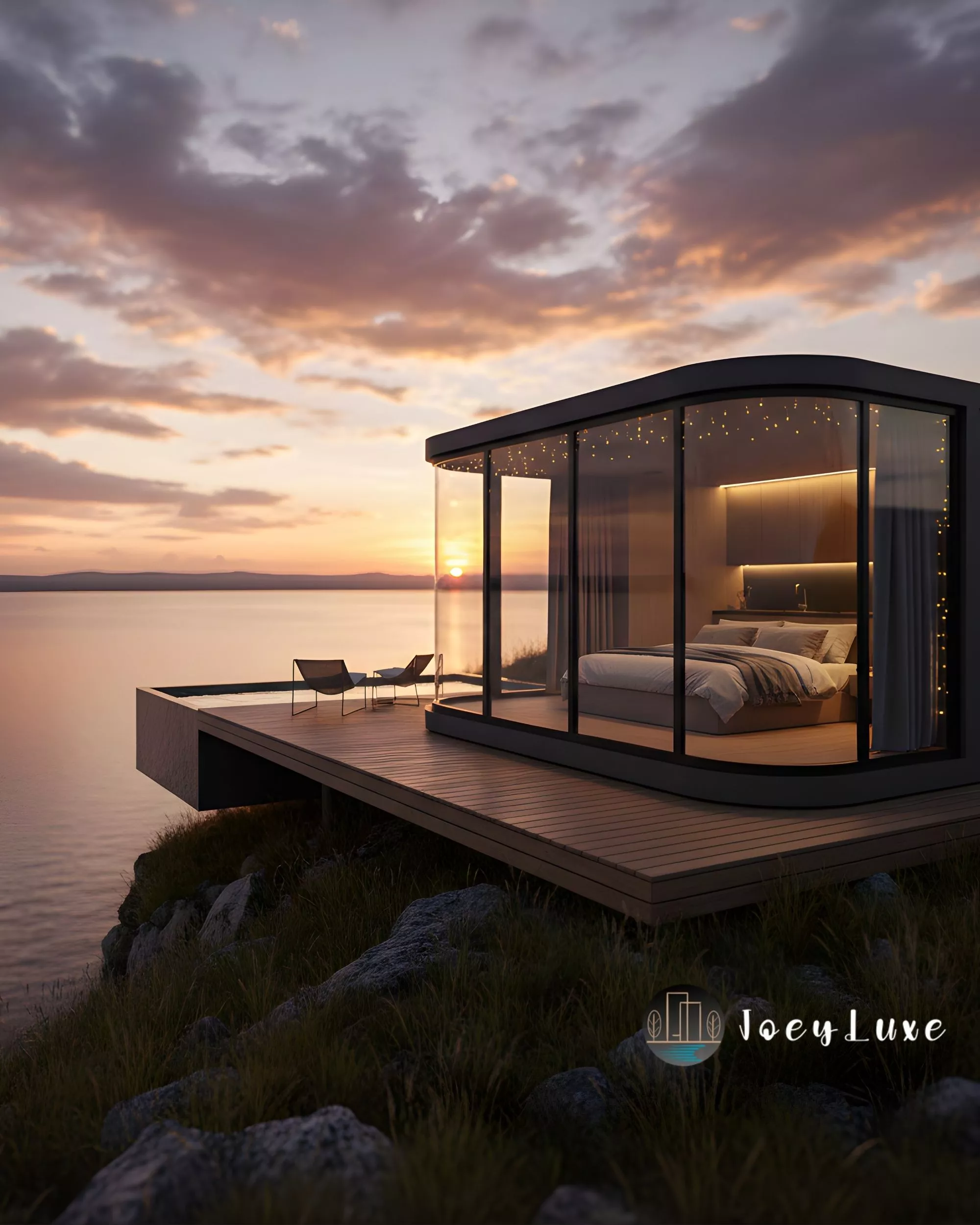
Before spending on development approval, site preparation, or unit orders, run a simple scenic quality test: stand at the position where you plan to place your unit's glazed face and take a wide-angle photo with a phone. Then ask honestly — would this photo make someone stop scrolling on Airbnb?
The most bookable glamping sites in Australia share one visual characteristic: they have a foreground-middle-background landscape composition. Something close (a garden, deck, meadow), a transition zone (treeline, ridge, valley), and a horizon (sky, ranges, water). This three-layer view creates the impression of depth and space that photographs compellingly and commands a premium rate.
A single-layer view — sky only, or a wall of bush — is bookable but not premium. No view, or a view onto infrastructure, fencing, or neighbouring properties — needs active management to remediate.
- Three-layer view composition (foreground, middle, horizon)
- Unobstructed primary view from the glazed elevation
- Natural light on the view face during guest peak hours (morning or late afternoon)
- Minimal infrastructure, fencing, or eyesores in the view line
What to Avoid
Red flags — sites that look viable but aren't
Each of the following conditions independently reduces rate potential or creates operational problems that compound over time.
Flat agricultural land without topography, water features, or significant vegetation has no natural rate driver. The unit is visible and bookable, but at Tier 3–4 rates with no natural pathway to premium positioning.
Traffic noise is consistently the most-mentioned negative in glamping reviews. Sites within 500m of a busy road, highway, or rail corridor will receive 3-star noise mentions that suppress booking velocity regardless of the unit's quality.
Low-lying land may have good creek or river views, but flood risk creates insurance challenges, guest safety obligations, and potential for expensive emergency management during bookings. Elevated positions almost always outperform flats on both safety and view quality.
Some rural titles carry covenants or are in zones that restrict commercial accommodation use. This is a pre-purchase check, not a post-purchase discovery. A planning consultant review of the title and planning scheme before any commitment is essential.
A genuinely remote site with no nearby tourism activity relies entirely on its own story to drive bookings. This requires significant marketing investment and typically delivers Tier 3 occupancy unless the site has an exceptional intrinsic drawcard — a unique landscape, wildlife, or activity offering.
A site that becomes impassable in rain creates guest cancellations, refund disputes, and reputational damage. Access track condition must be evaluated across all seasons, not just in dry weather when a site inspection is most likely to occur.
Quick Feasibility Check
A four-step process you can run on your own land this week
Run the scenic quality test
Photograph the site from the proposed unit position. Evaluate the view honestly against comparable Airbnb listings in your region at your target nightly rate. If the view doesn't match, identify whether it can be improved (vegetation management, unit repositioning) or whether the rate needs to be reconsidered.
Map demand drivers within 90 minutes
List the tourism attractions, food and wine experiences, and natural features within a 90-minute drive. Cross-reference with Airbnb search results for your region — what is the rate range for well-reviewed listings nearby? This gives you a real market ceiling, not an aspiration.
Check zoning and planning
Look up your land in your state or council's planning scheme. Identify the zone, the permissible uses under that zone, and whether short-term tourist accommodation requires a permit or is as-of-right. Note any covenants on the title. This is a 30-minute desk exercise that can save months of wasted planning.
Run the revenue estimate
Apply your likely rate tier to the ROI model on our Glamping ROI page. At the rate and occupancy your site realistically supports, what is the net annual income and payback period? If the numbers work, the next step is a formal site assessment.
Questions
Site selection — what operators ask us
Continue Reading
Related resources for glamping operators
Site Assessment
Talk to Joey Luxe about your site
Share your location, your land, and what you are trying to build. We will help you think through which site factors matter most for your specific situation.