
Rural land.
Earning its keep.
Millions of hectares of Australian rural land sits underutilised outside primary production. Capsule accommodation gives landowners a practical way to add a revenue layer — without disrupting the property or the lifestyle that comes with it.
Talk about your rural land Land monetisation overviewWhy rural land is increasingly well-suited to short-stay accommodation
A decade ago, converting rural land to short-stay accommodation meant expensive permanent construction, uncertain planning outcomes, and a dependence on the landowner managing every booking personally. The numbers rarely stacked up for smaller properties.
That picture has changed. The rise of Airbnb and Hipcamp has given rural operators national reach from day one. Guests have shifted their preferences decisively toward authentic, nature-connected experiences over generic hotel rooms. And modular accommodation — hotel-grade units that arrive ready to use — has brought the setup cost and timeline within reach of individual landowners.
The result is a genuine income opportunity that was not available to most rural landowners five years ago. This page covers the land types that qualify, the approval considerations, and realistic income scenarios across different property configurations.
Which rural land configurations work best for capsule accommodation
Not every rural block has the same potential, but a wider range of land types qualify than most owners expect. These are the configurations that consistently produce strong results.
Scenic bush and hinterland blocks
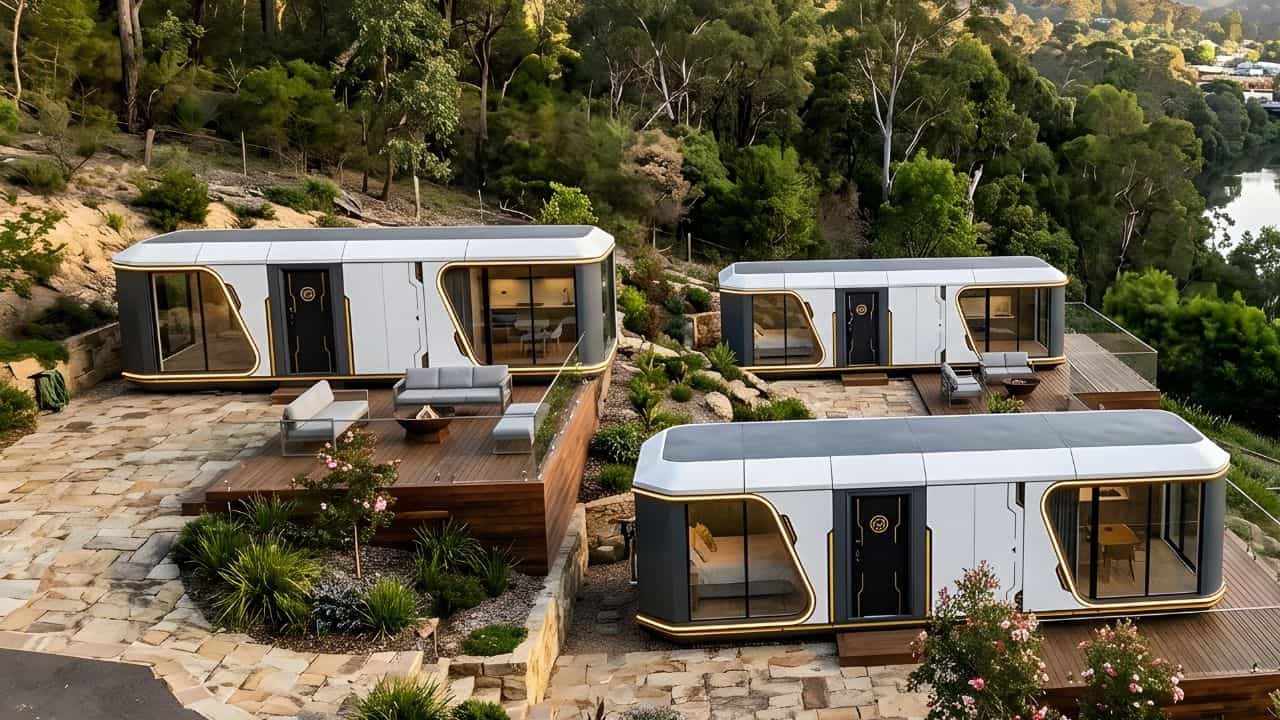
Properties with native vegetation, elevated ridge lines, or dramatic terrain draw guests seeking genuine nature immersion. Privacy and birdsong are amenities in this market segment — no additional infrastructure required.
Vineyard and orchard properties
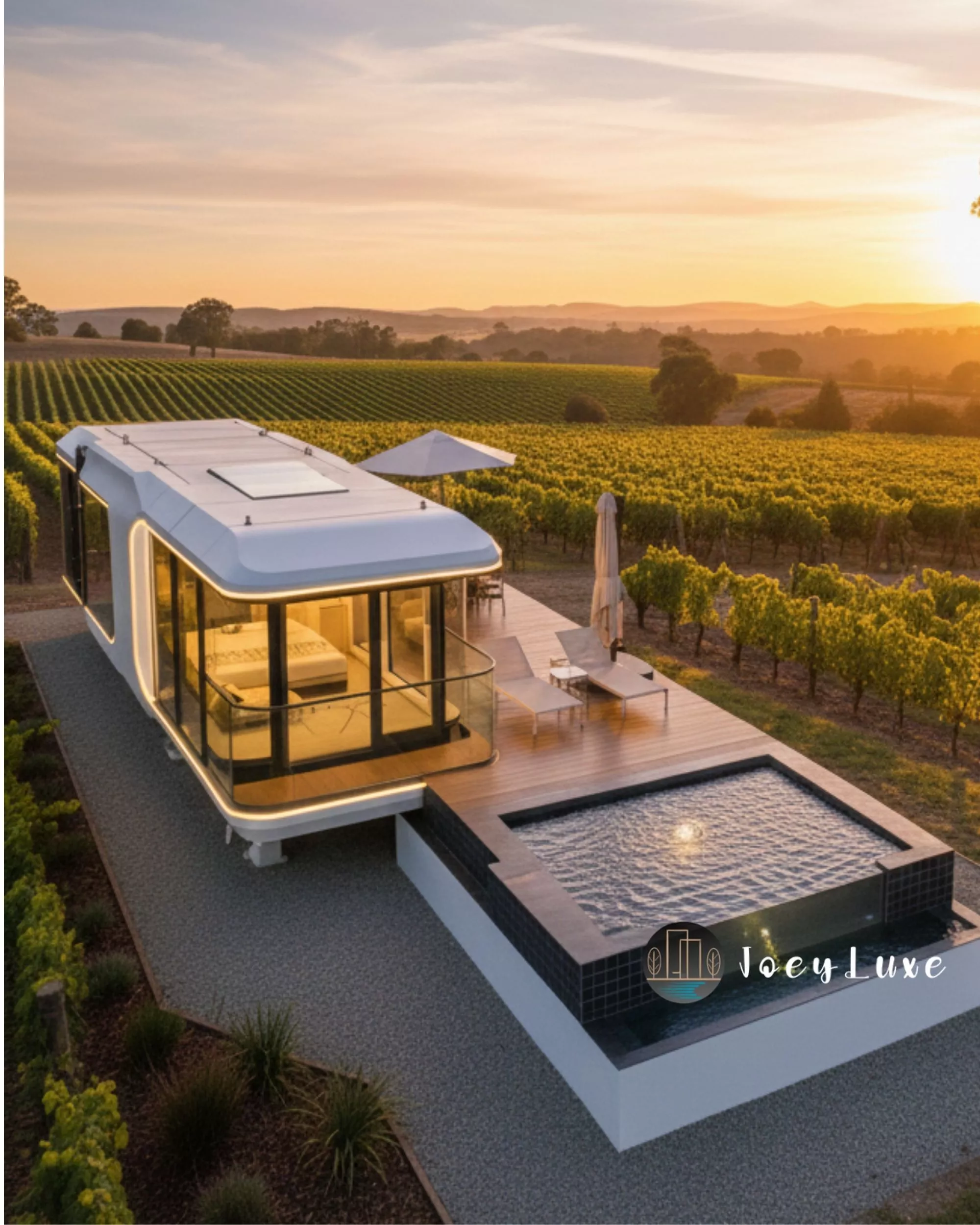
Working vineyards and orchards carry strong lifestyle associations that translate directly into booking appeal. Guests pay a meaningful premium to wake up surrounded by productive landscape rather than bushland alone.
Grazing and mixed-farming land
Farmland with visible animal activity — cattle, sheep, horses — is consistently attractive to guests from urban environments. The combination of space, quiet, and working landscape is the product; the capsule provides the comfort layer that justifies the price point.
Waterway and dam frontage
Creekside, riverside, and dam-frontage positioning consistently achieves the highest nightly rates among rural property types. Water creates a focal point for the guest experience and a natural photographic backdrop that drives social media discoverability.
Elevated rural lifestyle blocks
Rural lifestyle properties — typically five to fifty hectares — often have the scenic character to attract short-stay guests without the scale of a working farm. The absence of primary production activity can simplify planning pathways in some jurisdictions.
Timber, wetland and conservation parcels
Land held partly or wholly for conservation purposes is increasingly valued by the eco-conscious traveller segment. Capsules positioned sensitively in conservation landscapes attract a guest who will pay more, stay longer, and review better than average.
Understanding the approval pathway for rural short-stay accommodation
The planning pathway for rural accommodation varies significantly by state and local government area — but for most sites, a clear pathway exists. These are the typical steps.
Review your planning scheme
Identify your zoning and the land uses it permits. Look for provisions relating to tourist accommodation, short-stay, eco-tourism, or farm stay.
Pre-application council meeting
A pre-application conversation with your local council planning officer identifies any specific requirements before you invest in formal documentation.
Development application (if required)
Many modular installations are classified as temporary structures, which can exempt them from full DA processes. Where a DA is required, the modular nature of the build simplifies documentation.
Delivery and registration
Once approved, capsule delivery, site connection, and accommodation registration are typically completed within eight weeks.
What rural land accommodation can realistically generate
These scenarios are based on actual market data for Australian regional short-stay properties. Location and marketing quality significantly influence the outcomes.
Testing the model
One capsule at 55–75% occupancy and $180–$240 per night. Ideal for landowners wanting to validate demand before committing to a larger deployment. Manageable as a side activity alongside existing land use.
Meaningful passive income
Three capsules at 60–75% occupancy and $180–$240 per night. At this scale the operation generates income substantial enough to justify dedicated management and supports a professional guest experience.
Primary income potential
Six or more capsules at 65–80% occupancy and $180–$280 per night. At this scale the accommodation operation can stand as a primary business, supported by the rural setting rather than dependent on it.
Rural land does not need to be connected to produce income
One of the most common objections to rural accommodation development is the cost of extending grid power and water to a remote or semi-remote site. Joey Luxe capsules remove that constraint. Configured with solar generation, battery storage, rainwater collection, and appropriate waste management, a capsule can operate independently of all external services.
For guests, off-grid is not a compromise — it is increasingly a feature. The experience of staying somewhere genuinely remote, powered by the sun and surrounded by undisturbed landscape, commands the same nightly rates as grid-connected sites in the same region, and often higher.
The practical result is that rural land which would have been considered too remote for accommodation development becomes viable. If the landscape is compelling and the site is accessible, the services can follow the capsule — not the other way around.
Rural land accommodation questions, answered
Find out what your rural land could generate
Tell us about your property — size, location, current use, and access — and we'll give you a straightforward view of what it could realistically earn.
Talk to the Joey Luxe team